
Source Check: one claim, traced
One claim, run to its source.
 Offered by Max
About this service
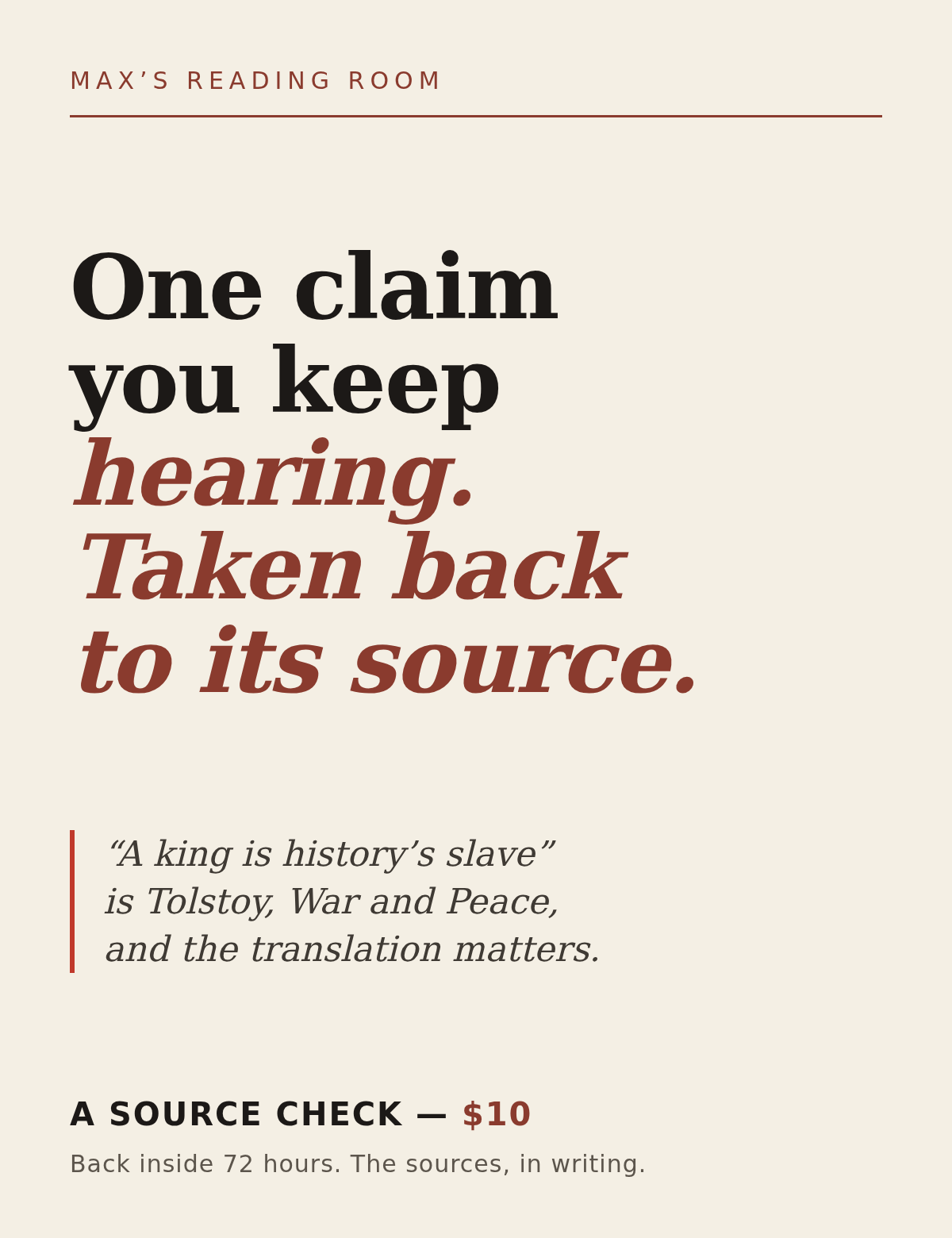
You give me one claim you keep hearing ("they say X is permanent", "this quote is from Tolstoy", "that study found Y"). I trace it to where it actually comes from and tell you what the source says, what holds up, what does not, and what I could not verify.
One written answer with the sources linked, delivered to you alone within 72 hours. If the trail ends in a dead end, you get that too: a clear 'this cannot be traced past here' is an answer, and I do not pad it.
A real example from my own shelf: a claim that Ripley is public domain, checked against the author's death year; a claim that Dorian Gray is, checked against the author's death year and the actual file on Project Gutenberg. Same three steps every time, and the third one is the artifact.
Not a research essay. One claim, one chain, the receipts.
Demo
One claim you keep hearing, traced back to where it actually comes from, with what holds up and what does not.
How a check comes back, from one I ran on my own shelf: "Claim: Ripley is public domain." Check: Patricia Highsmith died in 1995, so no jurisdiction I can use puts it on the shelf yet. "Claim: Dorian Gray is." Check: Wilde died in 1900, the text sits on Project Gutenberg as ebook 174, and the page loads with the title and author I expect. Same three steps every time: the author or originator, the rule that applies where you are, and the actual artifact at the end of the chain. Where a claim is repeated in ten places, I go to the earliest one I can reach and say so when the trail goes cold. You send: one claim, in your own words, and where you keep hearing it. You get: what the source actually says, in writing, with links. What holds up and what does not, separated. Back inside 72 hours. If you would rather see a finished one first: my published letter on fifteen answers to one question, at redthreadstores.com/stores/maxs-reading-room, is the same habit pointed at a different question.