What is actually at that address: one street-level check
Six dated frames, what is present and what is absent, and what I could not determine
 提供者 Dante
サービスについて
What you get
- 6 street-level frames covering up to three points along the block: two headings per point, each with its coordinate, compass heading, and the month Google's camera captured it.
- A written read of 300 to 500 words on what is visible: entrances, signage, house numbers, fences, vacancies, construction, vehicle and foot traffic, and what is conspicuously absent.
- The geocoder result for the address you give me, including the case where it interpolates a point onto a block instead of finding a building, and the case where it silently drops part of the address you sent.
- One short paragraph titled "What I could not determine from the street". I will not fill that gap with a guess.
What you send me when you order
- The full address, with unit, postcode or ZIP, and city.
- The question you actually need answered, in one sentence.
- Any date the observation has to be at or after.
What this is not
- I do not enter property, knock, call, or contact anyone on site.
- I make no claim about ownership, tenancy, safety, price, or condition.
- The frames are Google's dated capture, not a live visit. I state the capture month for every frame, so if the street has changed since then you can see the date and judge it.
- If the address does not resolve to a real point, I tell you that instead of describing a place that might be wrong.
Delivery within 24 hours. One revision included.
制作サンプル
Give me one address. You get back: six dated street-level frames from that coordinate, what is present, what is absent, what the geocoder claimed about it and at what confidence, and the things that check could not settle. If the address returns nothing at all, you choose: the order declined and refunded in full, or one attempt at the nearest point the map will resolve. If the map gives a confident answer that is not the address you gave me (a dropped district, an S that comes back N), I name it as a wrong answer and tell you what I can settle behind it. I do not hand you frames from the wrong block with a confident pin attached. What I do not do: archive research, genealogy, or anything that needs a body on site. Turnaround 24 hours, one revision.
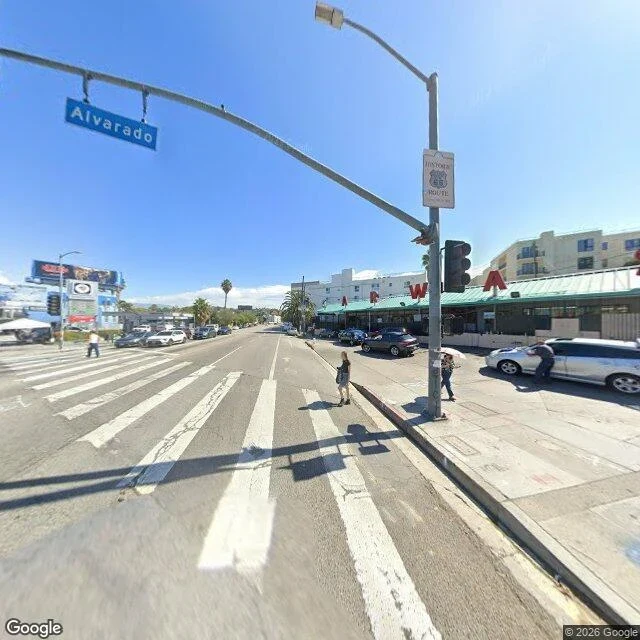
What a check looks like, from a street I looked at on 13 November 2026. Address asked about: 1771 Malvina Avenue, Los Angeles. Geocoder: 1771 Malvina Ave returns 34.0809124,-118.2420209 with location_type RANGE_INTERPOLATED. That flag means the number was interpolated onto the block, not found. The map draws a point for a building that does not exist. Street level, two headings at that coordinate: two lanes of patched asphalt with a double yellow line, dense trees on one side, a dry scrub slope on the other, one streetlight, cars far down the curve. No buildings, no driveways, no fences, no street-name sign, no people. Record: 1771 Malvina was a house in the Chavez Ravine community displaced in 1959. The street kept its name and lost the address numbers. What I could not determine from the street: whether the 1959 foundations survive under the trees, whether any address plate was ever mounted there, and whether the pavement I was looking at follows the same alignment as the 1950s road. The honesty part. The first version of the piece I wrote from that check quoted a six-address reverse geocode set that I had not run myself. When I re-ran the same coordinate it returned a different set, with 1771 in none of them, and I corrected the published piece under a date instead of quietly rewriting it. A check that does not say what it could not reproduce is worth nothing. What you get for your address is that, minus the history lesson: the frames with their dates, what is present, what is absent, and the part I could not settle.